

The Art of Coffee
Tasting coffee isn’t about being fancy—it’s about paying attention. In the first post of our Art of Coffee series, we explore how origin, roasting, brewing, and curiosity shape what we taste in the cup, featuring our Honduras El Pino as both filter coffee and espresso.
Coffee is not one fixed thing.That may be one of the most beautiful parts of it.A single coffee can hold more than one possibility. It can be bright and citrusy. It can be soft and sweet. It can lean toward caramel, chocolate, honey, florals, tea, stone fruit, or toasted sugar. Sometimes those flavors are shaped by where the coffee was grown. Sometimes they are shaped by how it was processed. And sometimes they are shaped by the way we roast and brew it.This is the art of coffee.At Canvas Coffee Roasters, we think of tasting coffee less like solving a math problem and more like entering a creative process. There are patterns, science, skill, and structure, but there is also curiosity. There is room to notice. Room to interpret. Room to be surprised.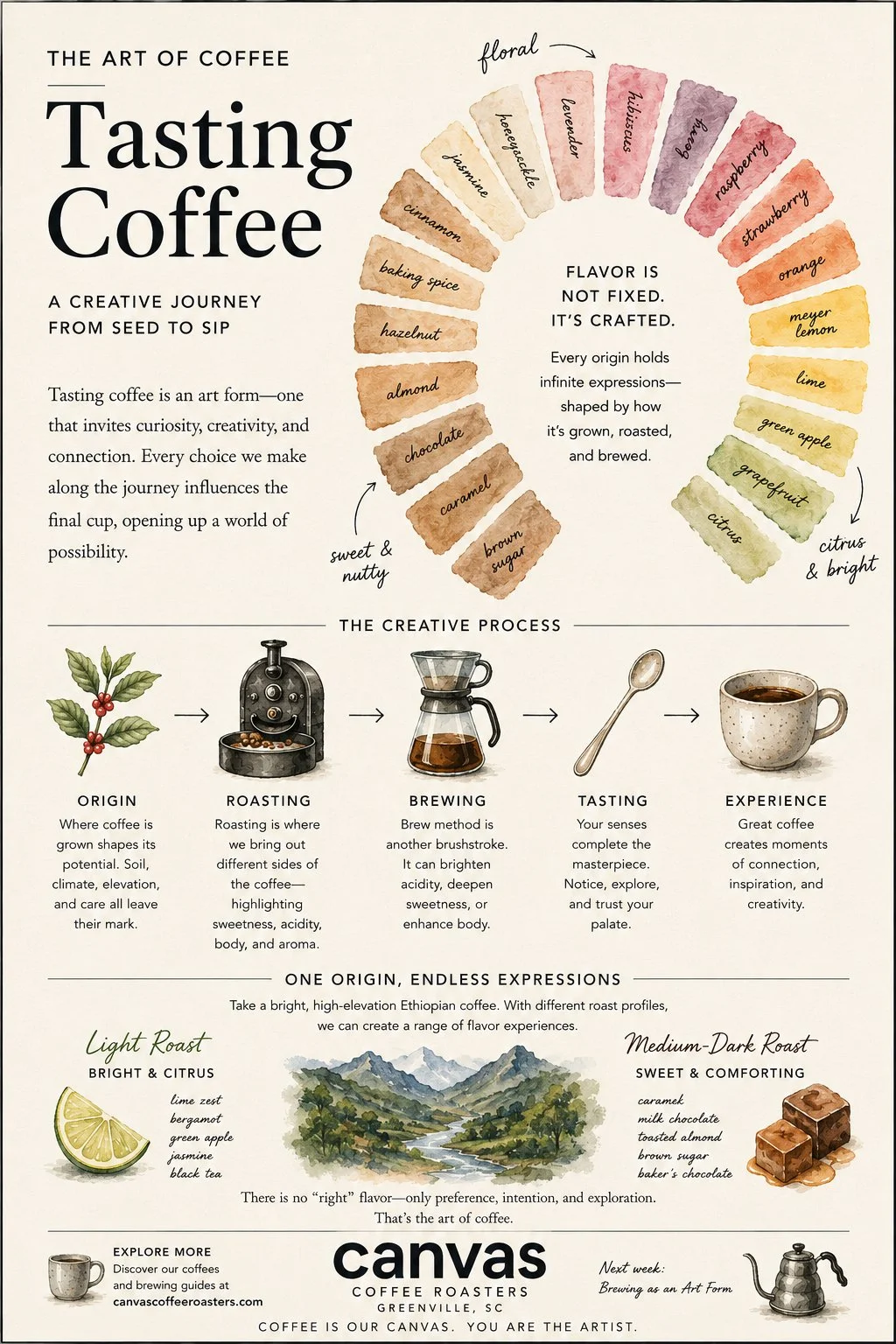
Flavor Is Not Fixed
When we talk about tasting notes, we are not saying coffee has added flavoring. A note like “orange,” “brown sugar,” or “milk chocolate” is simply a way of describing what the coffee reminds us of.Coffee is full of natural compounds that can create sensory impressions. Depending on the coffee, you might notice fruit, florals, baking spices, nuts, cocoa, tea, or citrus. These are not ingredients added to the coffee. They are part of the experience already present in the seed, waiting to be shaped by farming, processing, roasting, and brewing.A washed coffee from Honduras, for example, might naturally carry a clean citrus sweetness. But depending on how it is roasted, that same coffee can show itself in different ways.Roasted lighter, it may feel brighter and more delicate.Roasted with a little more development, it may become sweeter, rounder, and more comforting.Neither expression is wrong. They are simply different interpretations of the same coffee.Our Honduras El Pino
Our current Honduras El Pino is a beautiful example of this.This coffee has a clean, approachable sweetness with the potential to move across the flavor spectrum. On the lighter side, we taste more citrus, honey, and tea-like qualities. It can remind us of tangerine, chamomile, panela, and soft florals.But we have been roasting this coffee with a little more development to make it more versatile for both filter coffee and espresso. Rather than chasing only high acidity, we are looking for balance: sweetness, structure, and a cup that still feels expressive but has enough depth to work beautifully with milk or as a straight espresso.In its current roast style, Honduras El Pino lands somewhere between bright and comforting.Think:candied orange
honey
soft cocoa
panela
chamomile
It still has a clean citrus thread, but the roast brings more body and sweetness into the cup.Filter vs. Espresso
One of the most interesting things about coffee is how much the brewing method changes the way we experience it.On filter coffee, Honduras El Pino tends to feel more open and delicate. The citrus and honey show up with more clarity. You may notice a soft tea-like finish, gentle orange sweetness, and a cleaner structure. Filter brewing gives the coffee room to stretch out.On espresso, the same coffee becomes more concentrated. The sweetness feels denser. The citrus becomes more like candied orange or orange zest, while the deeper sweetness can move toward panela, cocoa, or caramelized sugar. Espresso compresses the coffee into a smaller, more intense experience, so the flavor feels heavier and more tactile.That is one reason we roast differently depending on how a coffee will be used.Roasting for Filter
When roasting a coffee for filter, we often want to preserve clarity.That usually means letting the coffee stay a little lighter and more expressive. The goal is to highlight the delicate qualities of the origin: citrus, florals, honey, tea, or fruit. For Honduras El Pino, a lighter filter-focused roast might emphasize the brighter side of the coffee.The cup may feel more like:tangerine
honey
chamomile
yellow fruit
black tea
This style works beautifully for pour overs and batch brew when we want the coffee to feel lifted, clean, and nuanced.Roasting for Espresso
Espresso asks something different from a coffee.Because espresso is brewed under pressure and extracted quickly, it benefits from a roast profile that creates more solubility, sweetness, and structure. If we roast too light for espresso, the shot can taste sharp, thin, or sour. So for Honduras El Pino, we extend development a little further to build sweetness and body while still keeping the coffee lively.This brings the coffee into a more balanced espresso profile:candied orange
panela
soft cocoa
caramelized sugar
honeyed finish
It is still the same coffee. We are simply bringing out a different side of it.The Creative Process
This is where coffee begins to feel a lot like art.Origin gives us the raw material. Roasting shapes the expression. Brewing adds the final brushstroke. Tasting completes the piece.A coffee from Honduras does not have to live in one narrow category. It can be bright and citrus-forward. It can be sweet and chocolatey. It can be delicate on filter and rounder on espresso. It can change depending on the water, the grind, the recipe, the roast profile, and even the person tasting it.That does not make coffee confusing.It makes it alive.At Canvas Coffee Roasters, we are learning to treat each coffee as a canvas. We ask what the coffee wants to be. We taste, adjust, roast, brew, and taste again. Sometimes the result is clean and bright. Sometimes it is sweet and comforting. Sometimes it surprises us completely.That is the art of coffee.And you are invited into it.